Showing posts with label ministry. Show all posts

Tuesday, June 14, 2022

Providence Karen Ministry

Interview by Ilse Vandermeulen as published in Clarion. Reprinted here with permission.


George van Popta, wearing a traditional Karen shirt he received on his birthday (the day the photo was taken), and Semula Horlings (front row, third from right) with the Providence-Hamilton participants of the online Bible course.


HAMILTON - Semula Horlings is a member of Providence Canadian Reformed Church in Hamilton and interprets an online bible course for Karen people taught by emeritus minister George van Popta through ZOOM. Two unlikely candidates, one a former refugee and one facing serious health concerns, called by God to share the Reformed faith with a growing group of young believers in several parts of Canada and beyond. In 2006 Semula arrived in Canada with her mother and two brothers as a refugee. Hiking along one of the rivers in the beautiful forests of her homeland Burma (now officially called Myanmar) is something she would love to do one day again. “There are lots of beautiful white lilies there, and many different kinds of orchids especially in the rainy season”, she recalls. Spring time in Canada, when everything turns green after a long winter, reminds Semula of her country of birth, which she fled when she was 17. She is not sure if she will ever be able to see Burma again, but what she is sure of, is that Jesus Christ her Saviour carried her through every day of her turbulent life. Burma is ruled by a military dictatorship for over seventy years. Since 1949 the country is in a civil war where the military tries to control several ethnic groups, especially the Karen people (pronounced Kuh-rèn). “The Karen were the first people in Burma, like the native people in North-America”, tells Semula. “It’s a long history of persecution by Burmese kings and now the military.” The Karen’s traditional religion was animism -the belief that objects, places and creatures possess a distinct spiritual essence-, but by the grace of God, in 1813, Baptist missionary Adoniram Judson landed in Burma from North-America to share the gospel.
Refugee Semula’s father was an evangelist, and at age 3, her parents took Semula and her two brothers out of their village because of killings, forced labour and torture of Karen Christians. “We were running as they burned down the houses. In thirteen years, we moved to 5 different locations”, tells Semula, who ended up in refugee camps in Thailand when she was 10 years old. At age 17 she lost her father who was killed while helping others escape. “We lived in constant fear and it was like a prison to me,” she says looking back to those days in the camps. In 2005 Semula and her family were offered an opportunity to come to Canada, a new, lonely and cold country. Semula was proficient in English and took on the role of translator for her family and many other Karen refugees as they had to navigate finding work, health care and the social system. The Immigration Working Centre in Hamilton asked her to interpret as a volunteer and she was able to attend college. Streetlight Semula longed for communion and worship with other Christian brothers and sisters in her new country. She found Streetlight Ministry in 2007 and started to attend Bible study. It was at Streetlight that she met her husband, Richard, whom she married in 2011. The couple now attend Providence Church after being at Streetlight for over ten years and have a daughter and a little boy. Semula: “Coming to Canada and having a faithful church is such a blessing to me. My identity is in Christ and that is how I connect with other fellow Christians, regardless of social status, education or possessions.” The catechism teaching made a deep impression on Semula. “It is the core of the gospel. I learned so much from the catechism and wanted to share that with my people. Many became Christians, but they have a lack of Biblical knowledge for several reasons. They are first generation believers. The Bible is not just a moral teaching, but the truth that makes us new.” Semula requested consistory to make catechism teaching available for a new immigrant Karen family and retired minister George van Popta was found willing to take on this task. At age 25 and still in seminary, reverend van Popta heard he had Multiple Sclerosis. “The first decade after my diagnosis I had many relapses and remissions; essentially it went quiet, but then the symptoms came back. The chronic pain was the most debilitating”, he says about his struggle with MS. In 2016, at 58, reverend van Popta decided to retire early from his congregation in Ottawa. “It was difficult. I loved the pastoral ministry and my congregation.” But he adds: “Little did I know that I would still be called to do mission work!” Old Testament After Rev. van Popta systematically went through the catechism Lord’s Day by Lord’s Day, he continued with teaching the Old Testament, starting in Genesis. “They knew the stories”, he notes of the participants, “but they had learned them in a moralistic way, not in a redemptive historical and Christological way.” The group grew with Karen people whom Semula invited to church. Others started to join by Facebook video chat. Reverend van Popta: “And then it was 2020 and with Covid everything came to a halt… But we were already online and we said: why don’t we continue with our video chat?” It opened up opportunity for relatives and friends from other parts of Canada to join as well. When the group exceeded the video chat capability, it moved to ZOOM and by now a group of fifty regular Karen attendants meet three times a month. The group did not shy away from the book of Leviticus. “We are at mount Sinai at the moment and we went through the five main sacrifices in the first chapters. After that I turned the attention to Leviticus 23 to explain the seven festivals.” Reverend van Popta says that the most common response from the group is that they never heard the Bible explained this way. The minister: “I am nothing special, but I have something they don’t, and that is our Reformed teachings of the Lord Jesus Christ in everything. He is clothed in the pages of all of Scripture, including the Old Testament.” The retired minister thoroughly enjoys his task of teaching. “I am profoundly thankful every day. I always had a heart for newcomers and people from different ethnicities. I was drawn to the Karen people who came to our church. Being retired, I had good opportunity and I feel the Lord brought me to this at His time.” Pastor or ‘Grandpa’ George and his wife ‘grandma’ or ‘mother’ Dora also very much enjoy getting to know the Karen people and their lightheartedness and joy. “As a people, they are family oriented, love laughter and social gatherings.” The minister stresses that it is important that the course should not be an end in itself, but that the participants need to connect to faithful churches in the areas they live. “The harvest is plentiful”, adds Semula, who is also in contact with Karen in Thailand. “It is such a blessing that we can share the gospel as Reformed churches with others, even in other parts of the world.” Reverend van Popta: “God can take something which we really dislike, COVID, and use it for the good progress of the gospel. The Lord Jesus is on the throne.”
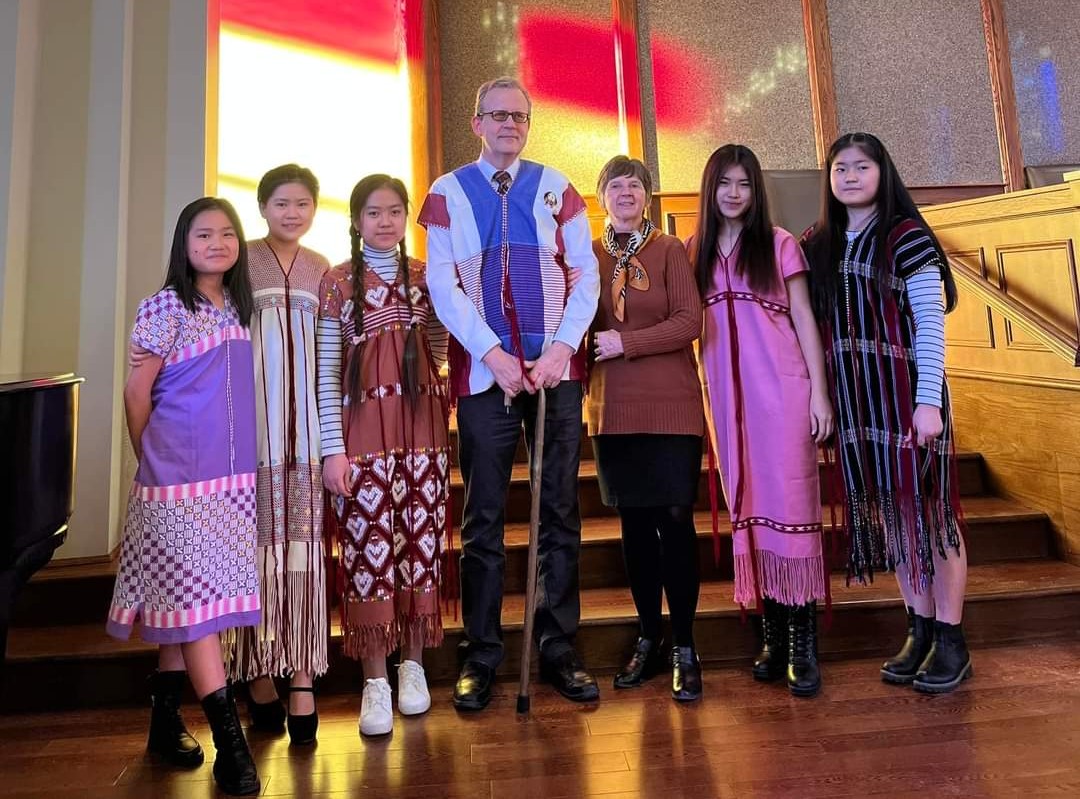
  

Grandma Dora and Grandpa George with their five Karen granddaughters Semula, in her own words (YouTube)

Thursday, December 01, 2016

Chapel Talk at CRTS


On being a pastor: some reflections

November 21, 2016
George van Popta
CRTS

Reading: Psalm 40.

I was ordained as a pastor 29 years ago. It seems a moment ago. In the Lord’s providence my ministry was cut short due to declining health. But I can only offer thanks to the Lord for his goodness and kindness in allowing me to serve in the pastoral ministry for 29 years. Over the years and across a number of congregations I was allowed to intersect the lives of many of God’s people. And that’s a privilege.

The pastoral ministry is a unique vocation. This morning I would like to offer a few personal reflections and seven words of advice (the seven are not necessarily in the order of importance).

Let me say first of all that though I don’t know what miry bog David was speaking about in Psalm 40:2, I know that the Lord graciously drew me out of a miry bog and set my feet upon a rock, one that is secure. That verse reads: “He drew me up from the pit of destruction, out of the miry bog, and set my feet upon a rock, making my steps secure.” The Rock is our Lord Jesus Christ.

My teenaged years were less than well spent. I will spare you the details, but let me only say that I was not living close to the Lord. Though I hardly missed a church service, my religion was pro forma and by rote. I did not have a close relationship with the Lord.

Sunday by Sunday I sat under excellent preaching, but I heard hardly a word. The pastor of my youth is known as having been an outstanding preacher among Canadian Reformed preachers, but his silvery voice only lulled me to sleep. I say that to my shame.

In the Lord’s providence a young preacher came by several times a year on the local pulpit rotation. He preached so earnestly and with such conviction that I finally awoke and realized that what the men in the pulpit had to say was actually quite important. It was life-changing for me and set me on the pathway to the ministry. There were a few hiccups along the way, all of my own fault, but the Lord began to pave the way. Once he had set my feet upon the Rock, my steps were secure. He gave me a wonderful woman to be my wife, and shortly after we were married I began my academic career.

After four years at a university for my BA I landed here at CRTS--or rather, at the Queen Street incarnation of CRTS in the lower city. It was at CRTS that I became ill and I remember with fondness and gratitude how my professors, to a man, all encouraged me not to give up but to carry on with my studies.

I was ordained before the excellent provisions of internships and mentorships. In that day we were walked to the end of the pier and given a little push. Let me hasten to add that all manner of unofficial mentorships were informally arranged between us young guys and older colleagues. For me the Rev. Hans Mulder was always just a phone call away and he gave me much valuable advice especially during my first years.

1. That would be my first word of advice: have contact with an older and experienced colleague. Speak regularly with him about the facets of the ministry, and about your joys and struggle. You receive an incredible education. In addition to the high academic standards that prevail here, students at CRTS are trained and taught by men who themselves have been in the pastoral ministry. They, themselves, have experienced the full range of all the highs and lows of our vocation. Seminarians who are trained by former pastors are uniquely blessed. But in addition to that, once you are on your own pastoral turf, seek a Paul/Timothy type of relationship with an older and well seasoned colleague.

2. Value your elders. I was so blessed as to have excellent elders in my first congregation--in fact, I did in all of them. But I remember with great fondness my first elders. I remember the first home visit that I led. We were going to visit two couples that evening, an elderly one and a young recently married couple. The elder gave me the choice of which visit to lead. I chose the young couple as I thought that would be the easier visit. Was I wrong! Every question I asked was met with a mono-syllabic answer, and after about 10 minutes my mouth felt like it was stuffed with cotton. The kindly elder rescued me. Blessed are you if you are received into a circle of good elders.

My second word of advice: greatly appreciate your first elders. Not only the first, but especially the first.

3. My third word of advice is to foster contact with colleagues. In my last congregation, Jubilee Ottawa (which was both my first and my last congregations), I met every six weeks or so with a number of colleagues for breakfast and prayer. Ottawa may be the capital city of Canada, but there is not much of a confessional Reformed witness in that part of Canada. To my knowledge there are only two confessional Reformed churches between Bowmanville and Ottawa: one in Kingston and one in Brockville. I got together regularly with men from a half dozen different and small NAPARC churches, from upstate NY and Eastern Ontario, for prayer. This was invaluable, and I encourage all of you wherever you end up to foster that. A few colleagues and I here in Hamilton have begun meeting monthly for prayer, and it is a blessing.

4. Fourth word of advice is to pace yourself. Ensure that you are active, not busy. I think that there is a difference between being active and being busy.

On the one hand, being active means that you are consciously thinking of what to do, how to do it, when to do it, and why. One who is active is in control of things. He knows what he is doing and why he is doing it. And he is productive.

On the other hand, one who is busy is controlled by the many things there are to do. A busy person is the victim of his calendar and the many things on it while an active person  is in control of his agenda. A busy person runs around trying to get things done, and he does a bit here and a bit there producing little. An active person focuses on the task at hand and is more productive than the busy person.

Be active; not busy. As I look back on my ministry I know there were times that I was busy. I was overwhelmed by things. There is so much to do in the ministry: sermons, catechism lessons, visits, committee (local and federation). There is no end to the demands on one’s time. If you find that you are just busy and a victim of your agenda, it will be time to take a step back and, give up a few things, and learn to say “No.” I had to learn that. At one point  I was the solo pastor of a congregation of 600 souls. In addition to the preaching and two full evenings of catechism for covenant youth and new members, there were endless visits that needed doing, young couples to help prepare for marriage, and much too much committee work. My wise consistory told me to give some of it up. There are many capable people in the congregation and federation and you can say “No” to things and let another do it. It will get done. The great thing about giving up a good chunk of your work is that you can give up what you don’t really like doing and say, “My consistory told me I had to give it up.”

5. A fifth word of advice: If you have some extra time to make one more visit, visit the person that you do not really feel like visiting. Some people are very pleasant to visit, and might even be a friend; other people are not very pleasant, or even somewhat difficult. If you have a bit of extra time, visit that latter person.

6. Stay humble. There is no room for pridefulness and conceit in the ministry of Jesus. Make the Lord your trust. Psalm 40:4 says, “Blessed is the man who makes the LORD his trust, who does not turn to the proud and go astray after a lie!”

That counts for all of us today: Whether you are part of the faculty, the staff, or the student body, or retired, make the LORD your trust. For the students, today you need to make the LORD your trust, and you will need to do so when you are in the ministry. Do not turn away to pride nor follow the lie. A minister has a central place in the midst of the congregation. It is easy to become prideful and to start listening to the liar, the deceiver. Satan’s fall was due to pride and he became the liar. Don’t go there. Don’t go the way of pride, the way of the great liar. Rather, go the way of humility following Jesus who humbled himself and gave us an example for us to follow.

7. The last word of advice: worship. You will be the worship leader. Do not forget to worship. During the Sunday services when God’s people are gathered for worship, ensure that you are in their midst. Even as you are in the pulpit and do most of the talking, ensure that you are a brother amidst the children of God worshiping our LORD. It is worship that centres us, refreshes us, and invigorates us.

There are many other things we could talk about: marriage, family, personal devotions, having a good novel on the go at all times, hobby, physical exercise, diet, but then I’d be speaking far too  long. Please accept these reflections and words of advice, and may the Lord bless you all. Know that if you make the LORD your trust, you will be blessed.

Thank you!