Showing posts with label Fransje. Show all posts

Friday, April 19, 2024

Baby visit

 Baby visit


Nijsterweerd is a bustling Dutch village teeming with children. The lone school is bursting at the seams, and maternity visits are a near-weekly occurrence. Initially, my husband, Pastor Kees, and I would attend these together. However, Kees found that these visits often devolved into too much “women’s talk.” Consequently, we decided to make these visits separately. Kees had hoped to avoid the detailed birth stories this way, but alas! Few women in Nijsterweerd can resist sharing their dramatic birth experiences, even with their 25-year old newlywed pastor. “I should have become a baker,” Kees would quip; “at least bakers don’t have to listen to such stories. But Fransje, when are you going to visit Griet?”

That question puts me squarely in the middle of a dilemma. “I’m apprehensive,” I admit. “What if she thinks I’m visiting out of mere curiosity, Kees? She might not appreciate it.”

“You must, Fransje,” insists Kees. “Your absence would not be seen as tactful, but rather as if you’re looking down on her, just like the other women. Just be yourself,” he advises. “Follow your heart.”

Poor Griet. A year ago, she moved from the southeastern corner of Friesland to our village of Nijsterweerd in response to a housekeeper advertisement. She found herself in the remote area of Bergwier, a village down the road from ours, a place seemingly near the end of the world. Her only company was her employer, Meindert, a deaf, inflexible, bachelor farmer in his fifties. Griet married him three months ago, and they welcomed a baby last week.
I’ve never met Griet, but I feel like I know her through Kees’s  stories. Griet is an unfortunate soul, somewhat of a social outcast who has never had anyone care for her. She lost her parents at a young age and has never had a place to call home. Kees has spent a lot of time talking to her and has grown fond of Griet. However, Nijsterweerd can be harsh, even towards those who have admitted their mistakes. It will take time for the village to accept Griet.

As I stand in front of my dressing table drawer, I ponder over the gifts for the newborns. I need to choose something for Griet. They’re just small, homemade items—a terry cloth bib, a knitted cap, a pair of baby socks. If I had known Nijsterweerd would have so many babies, I might have reconsidered. I chose something special, a little outfit I had sewn.

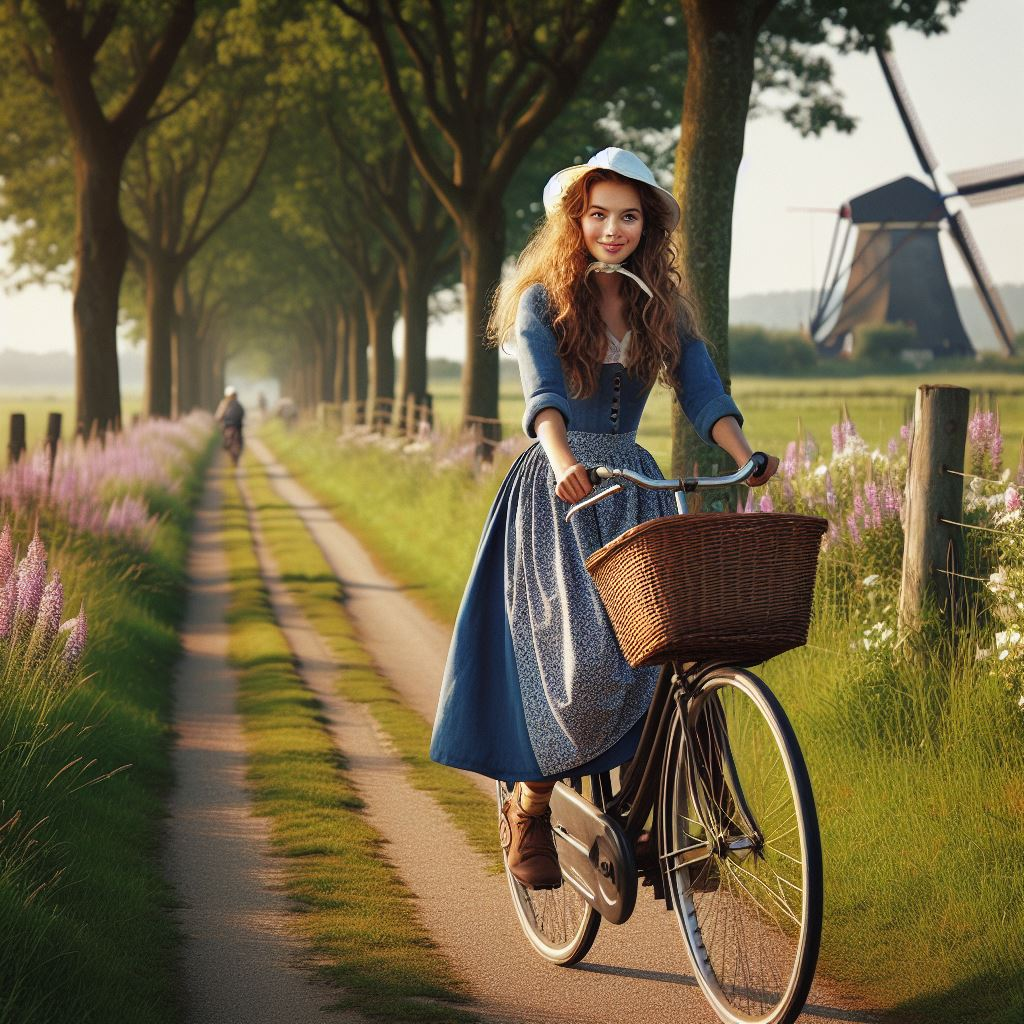
The road to Bergwier is barren and exposed, with a biting sea breeze. Despite my apprehension, I know I must bring the visit. In my bicycle basket, I carry the little package. I had sewn the outfit as a gift for Kees’s sister Ina, who is expecting her fourth child. But Ina will receive plenty of gifts, and Griet has no one.

Meindert is chopping wood outside. He mumbles under his breath and gestures towards the door of the house. I carefully navigate my way past the dog frantically barking and pulling at its chain.

The small room is stifling. Diapers are drying around the wood-burning stove, and a coffee pot is simmering on it. Griet lies in the bedstead, the bed built into the kitchen wall, her gaunt, yellowish face hidden among the checkered cushions.

“Ma’am,” Griet says, visibly distressed. She sits up halfway, tucking her dark hair behind her ears. “Ma’am, please excuse the messy kitchen. Geertsje from Minke, our neighbor, is coming to help this afternoon.”

I take a seat by the bedstead. Griet nervously fiddles with the sheets, chattering incessantly in an unfamiliar dialect. I can only comprehend half of what she’s saying. Eventually, she leans back into the cushions, exhausted. 

“Could you please pick up the baby? My husband won’t hear me if I call.”

Relieved that the intimidating Meindert will stay outside, I lift the sleeping child from its crib. Griet tucks the baby under the covers next to her with shy pride, and I get a glimpse of the wrinkled little head through a gap in the shawl.

I place my package on the blankets. Griet picks it up and unwraps the paper with trembling fingers. She holds up the outfit and looks at it in silence. Then, unexpectedly, she bursts into sobs.

Startled, I sit on the bench next to the bed. “But Griet,” I stammer, “why are you crying?”

“Oh,” Griet sobs, “such a beautiful gift! And the women said: You probably won’t get anything from the pastor’s wife.

When I return home, Kees has tea prepared. My chair is by the stove, the table lamp is lit, and my slippers are warming on the hearth. I almost feel guilty for enjoying such comfort and coziness, such care and love. I think of Griet in her cramped bedstead, with a deaf, gruff man as her only company, and a neighbor’s child as her only help.

When I recount my visit, Kees has only one comment: “That's cruel.”

----

From Fransje en haar dominee (Fransje and her pastor), 1953, by Margaretha Elisabeth Gilhuis-Smitskamp (1908-2008). The book is made up of 25 short stories about life in the village parsonage in the 1930’s and ‘40’s. Mrs. Gilhuis-Smitskamp was a pastor’s wife and writes from that perspective. Tr. George van Popta, 2024.


Thursday, February 29, 2024

Winter

Winter

Five o’clock. . . .

With a sigh, I place my knitting on the windowsill. The fading light makes it too challenging to work on the intricate pattern for my new sweater without making mistakes. Now, I’ll sit by the window and wait for my pastor husband Kees. It’s hardly worth turning on the light before he arrives. Earlier today, at one o’clock, Kees went into the countryside with Elder Groensma to bring some home visits. Such visits are customary in the afternoon, as people in the farming community retire early in the evening. Since half past one I’ve been knitting here, gazing out the window. After the schoolchildren clattered by on their wooden shoes at four o’clock, one man passed by with a sheep on a rope. But that’s been all—no one else.

Five o’clock. . . . Around this time of the day, I used to be on my bicycle stuck in a traffic jam at a traffic light in the busy city I grew up in. Sometimes it was with Kees, if he had a lecture scheduled then, or occasionally with colleagues from the office. Back home, Mother would wait by the fireplace, ready with tea and cookies, and stories about what had all happened that day. My brothers would noisily return from school, and my sister Riet would be back from a day of classes at the university. Cozy, warm, and filled with light—the house buzzed with life. The perfect Dutch word for it is “Gezellig!”

Now, in this little country village, life is quiet and slow. In the twilight of the street, someone approaches. Is it Kees? No, it’s a man in a blue coat, striding on toward his home. He sees me peering out the window and raises his index finger in greeting. “Hey!” Then he leans into the wind, which gusts freely at this corner. On this side of the village, the land is flat, devoid of trees or bushes, stretching to the seawall.

Dark early, cold, raining. That’s what it's like in Holland in December. How different everything seemed in June, when Kees and I visited after he had received the call to serve as pastor of the village church! I remember girls with red headscarves working in the fields, wagons piled high with hay, and shouting schoolchildren. A vivid picture indeed!

Two figures emerge from the misty twilight. Kees and Brother Groensma, finally! For a moment, they continue their conversation beneath the glow of the street lamp—the old man in his duffel coat and Kees in his light raincoat. One more handshake, and then Groensma heads off toward his home walking briskly on his stubby legs.

Am I feeling sentimental this afternoon? Kees suddenly looks hopelessly young, and it tugs at my heart! I know he finds home visits challenging. The elders often remain almost completely silent. They assume Kees will handle it all. After all, he’s the minister! But Kees just turned twenty-five—he was ordained as a pastor only six months ago. It all happened so swiftly: final exams at the seminary, several calls, classis exams, marriage—perhaps too swiftly. Being an assistant preacher for a few years wouldn’t have been so bad.

We sit down for a sandwich. Kees looks tired; his face wears an absent expression. It has indeed been a difficult afternoon.

“You pray, Frans,” he says. “I’ve prayed six times today: four home visits and two visits to the sick. Three cups of coffee and two cups of tea. And I suspect that old sister De Zwart is miffed that I refused her offer of tea.”

I’m relieved I saved a bowl of soup for Kees. I know better than to bring up the subject of tea or coffee after all those home visits.

After fifteen minutes of silent eating, Kees’s face relaxes. This is when he starts acting a bit silly. The nonsensical chatter he utters is meant only for the ears of his wife, who must be quiet and just listen. Afterward, I may recount my own experiences from the afternoon—namely, nothing!

After dinner, we take a leisurely walk up the road. I haven’t stepped outside all afternoon, and the fresh air is invigorating. The twinge of homesickness I felt earlier has disappeared.

In the twilight’s darkness, Kees unburdens himself. “Do you grasp how challenging it is, Frans?” he asks. “Imagine bringing a visit to old Brother Berkman—such a seasoned pioneer, well into his eighties. He has served as an elder, altogether, for over thirty years. And there I am, expected to pray. Let me tell you, I broke into a cold sweat. It would have been far better if he had prayed for me.”

“But he does, Kees,” I interject. “Yes,” Kees replies with a sigh. “He should recognize how much I need it.”

Back home, I receive a detailed account of Kees’s visit to Brother Geert Petrolie’s. Geert proudly displayed the new long johns and undershirt he received from the Sister Association. “Like a mannequin, he posed for me, stretching his arms in every direction to demonstrate the perfect fit. We must visit him again next week, Frans,” Kees suggests. “He’s a lonely old soul. Perhaps you could prepare some soup for him. But don’t forget to put on your stockings,” Kees adds with a grin.

Ah, my soup-splattered stockings—a source of amusement for Kees! During a recent visit to an elderly woman, who lives several kilometres from the parsonage, the soup I was bringing her ended up all over my stockings. I had hung the soup pan on my bicycle handlebars, and with each bump in the road, a little splash escaped. By the time I reached my destination, only the meatballs and a few noodles remained at the bottom of the pot.

And so we labour on in the task to which God has called us. We earnestly pray that our work may bear fruit.

 -----------

From Fransje en haar dominee (Fransje and her pastor), 1953, by Margaretha Elisabeth Gilhuis-Smitskamp (1908-2008). The book is made up of 25 short stories about life in the village parsonage in the 1930’s and ‘40’s. Mrs. Gilhuis-Smitskamp was a pastor’s wife and writes from that perspective. Tr. George van Popta, 2024.


Thursday, January 25, 2024

Crossing the Threshold


Crossing the Threshold
The parsonage in a Dutch village, 1929

Our arrival at the parsonage of the church to which my new husband Kees had been called was far from the elegant and graceful occasion we had envisioned as newlyweds. A hat played a role in the drama. Not my beautiful gray hat, which I had bought a few weeks before our wedding, the first hat I had ever bought, and which I thought made me look like a proper minister’s wife. No, it was my husband Kees’s top hat.

We had tried to sneak away after the ceremony, pretending we were just going for a stroll. Kees—the darling—hated making a fuss. Also, once we were on our way, he did not want anyone to know we were newlyweds, but the shiny new top hat box gave us away. It was like wearing a sign that said: These People Are On Their Honeymoon! We thought we had sent it along with all our earthly possessions to our new home, but, somehow, we had forgotten.

We had kept our destination a secret from everyone at home, but after several days we sent a message from our hotel to let them know we were alive and well. A day later, upon returning from a lovely walk, we found the front desk clerk anxiously waiting for us with a message for me: “You have received two calls from home, and they want you to call back right away. It sounded urgent.”

We ran to the phone, wondering what could be wrong. Was it Mother? Father? An accident? No, it was Piet, my brother.

“So, little sister,” barked the indignant voice on the other end. “Would you please return my top hat, which that husband of yours has run off with?” “Whoa!” I said in innocence. “Yes, whoa! Instead of his hat, he took mine, which, at considerable cost, I had rented for your wedding. They are charging me more every day! Kees will have to pay for that! Send it back immediately. Kees’s is already on its way to you.” We couriered Piet’s to his address, but he sent Kees’s to us at our hotel!  

We didn’t think that Kees should wear a top hat with his khakis. So, we had to lug it around with us for most of a week while we continued our trip, until we arrived at the parsonage. The bus dropped us off with our bags and boxes at the gate to the house. Daylight was quickly fading. And, of all things, the gate was locked! At least, we could not open it.

“The porch light isn’t on,” Kees said, puzzled. “Everything looks closed. Mr. Boomsma, the church custodian, said he would be waiting for us, and that his wife would serve us tea and cookies.” He trailed off, wondering what was going on.

“Oh, Kees,” I said, thrilled. “This is much more fun! We have the place to ourselves! And did you know that . . . a bride can’t touch the threshold the first time she enters her house? Her husband has to carry her over it! This is so romantic!” “You could just step over it,” Kees said sensibly. “Besides, how are we going to get into the house with this gate locked?” There we were, with two large suitcases, a violin case, and a top hat box. “You stay here,” Kees said. “I’ll get the key from Mr. Boomsma. He lives beside the church. Or maybe we should. . .? It’s not too high, and no one’s watching.” So instead of being swept into her house by the strong arms of her husband, the fragile bride had to help haul two heavy suitcases over a fence. And when the proud groom, with a careless gesture, tossed the hat box onto the walkway, the lid came off, and the shiny top hat rolled down a grassy slope towards a water-filled ditch.

Kees dove after it as if he were saving a precious child from drowning. He snatched it just before it sank into the green slime. And I—well, I couldn’t help myself. I collapsed, laughing so hard I thought my sides would split. 

We dragged everything to the back door, which, to our surprise, was unlocked. We couldn’t find the light switch, so we groped our way through the dark house, which smelled of new paint, new curtains, and mold. But it was our own house, and when I shone Kees’s flashlight I joyfully recognized all the nice things we had bought or received as gifts, which we had arranged to be shipped to our new home. “Oh, look,” I exclaimed when I found my kitchen, “now I can make tea for us in our own home. . . .”

“How did the pastor and his wife get in?” said a gruff voice. I looked up and saw Mr. Boomsma, huge and imposing, standing in the doorway.

We found the light switch and turned it on. Mr. Boomsma came into the kitchen. He said he had not received Kees’s postcard with our arrival time.

“How did you know we were here?” Kees asked, puzzled.

Mr. Boomsma gestured with his thumb over his shoulder to the silent road behind him. “The neighbour lady from across the road. She saw you two climbing over the fence and came to tell me you were here.”

That night, I learned that “don’t worry! no one will see you” is not a phrase known in this village. Behind every closed curtain, eyes are watching the parsonage and its residents.


------------

From Fransje en haar dominee (Fransje and her pastor), 1953, by Margaretha Elisabeth Gilhuis-Smitskamp (1908-2008). The book is made up of 25 short stories about life in the village pasonage in the 1930’s and ‘40’s. Mrs. Gilhuis-Smitskamp was a pastor’s wife, and writes from that perspective. Tr. George van Popta, 2024.